

PROJECT OVERVIEW
Client Follow-Up Workflow
- Category
- Automation & Integrations
- Type
- Workflow Automation
- Status
- Completed
THE SITUATION
Follow-up was fragmented across status, timing, tasks, and records.
Status changes could require a follow-up, but timing rules, task ownership, and interaction records were handled separately. That made the process harder to execute consistently and harder to review afterward.
WHY IT MATTERED
A follow-up workflow is only reliable when the next action is clear.
- Follow-ups could happen late
- Task ownership could become unclear
- Interaction history could become incomplete
THE APPROACH
Turn every qualifying status change into a controlled next action.
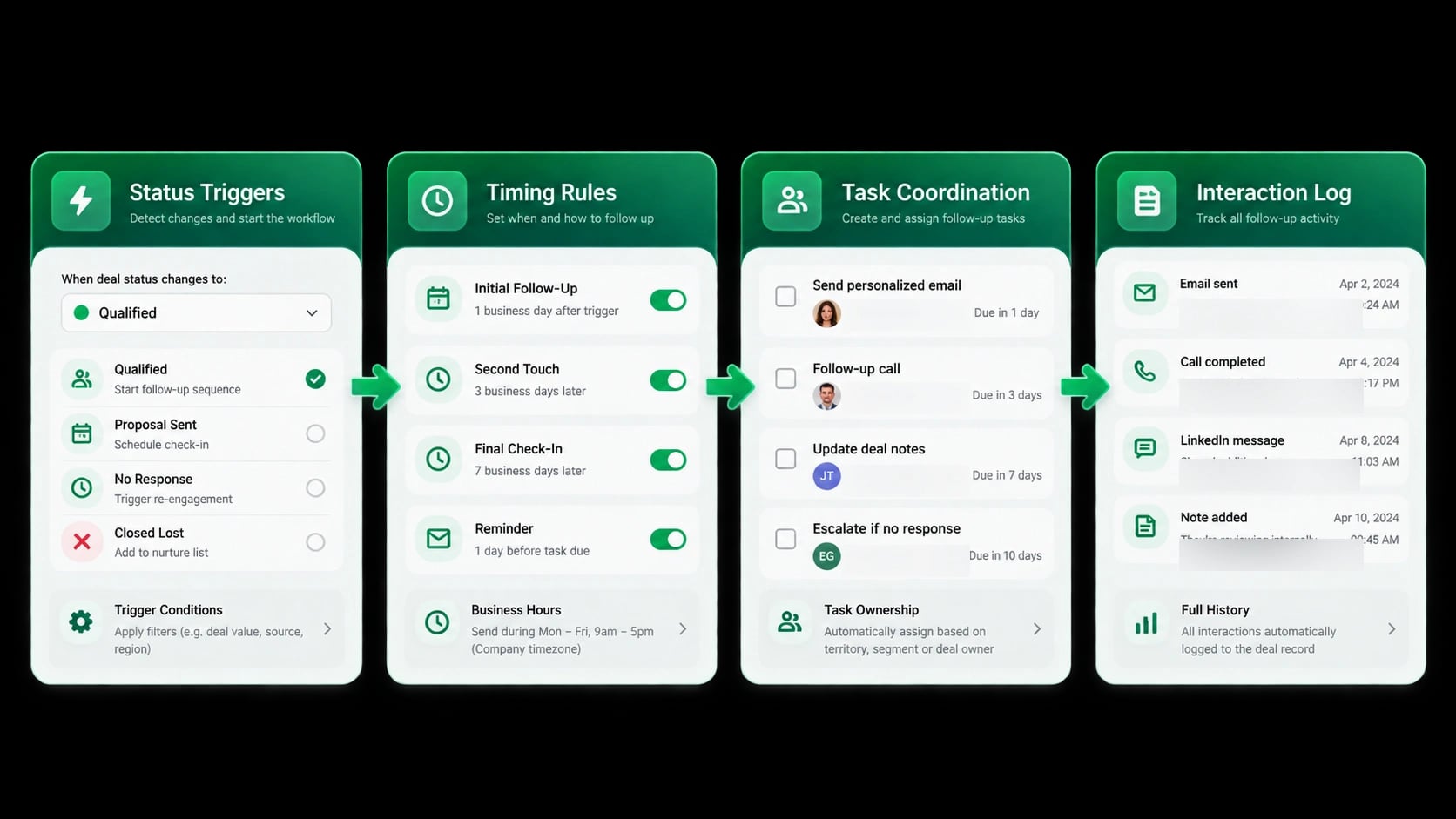
The workflow was designed around status and timing conditions. When a relevant condition is met, the system determines the next follow-up, coordinates the related task, and records the resulting interaction.
VISUAL PROOF
System in action
See the workflow move from status change to recorded action.
THE OUTCOME
Follow-up became a coordinated workflow instead of a set of disconnected actions.
Before
- Timing checked separately
- Follow-up tasks handled separately
- Ownership managed outside the follow-up flow
- Interaction notes recorded separately
After
- Timing evaluated through workflow rules
- Tasks coordinated from workflow conditions
- Responsibility tied to the next action
- Follow-up activity captured in the interaction log
SYSTEM DETAILS
Project Details
- Category
- Automation & Integrations
- Type
- Workflow Automation
- Status
- Completed
- Platform
- Make
System Modules
- Status triggers
- Timing rules
- Task coordination
- Interaction log
THE TAKEAWAY